Currently Empty: $0.00
Forklift vs. Scissor Lift for Industrial Material Handling and Elevated Maintenance
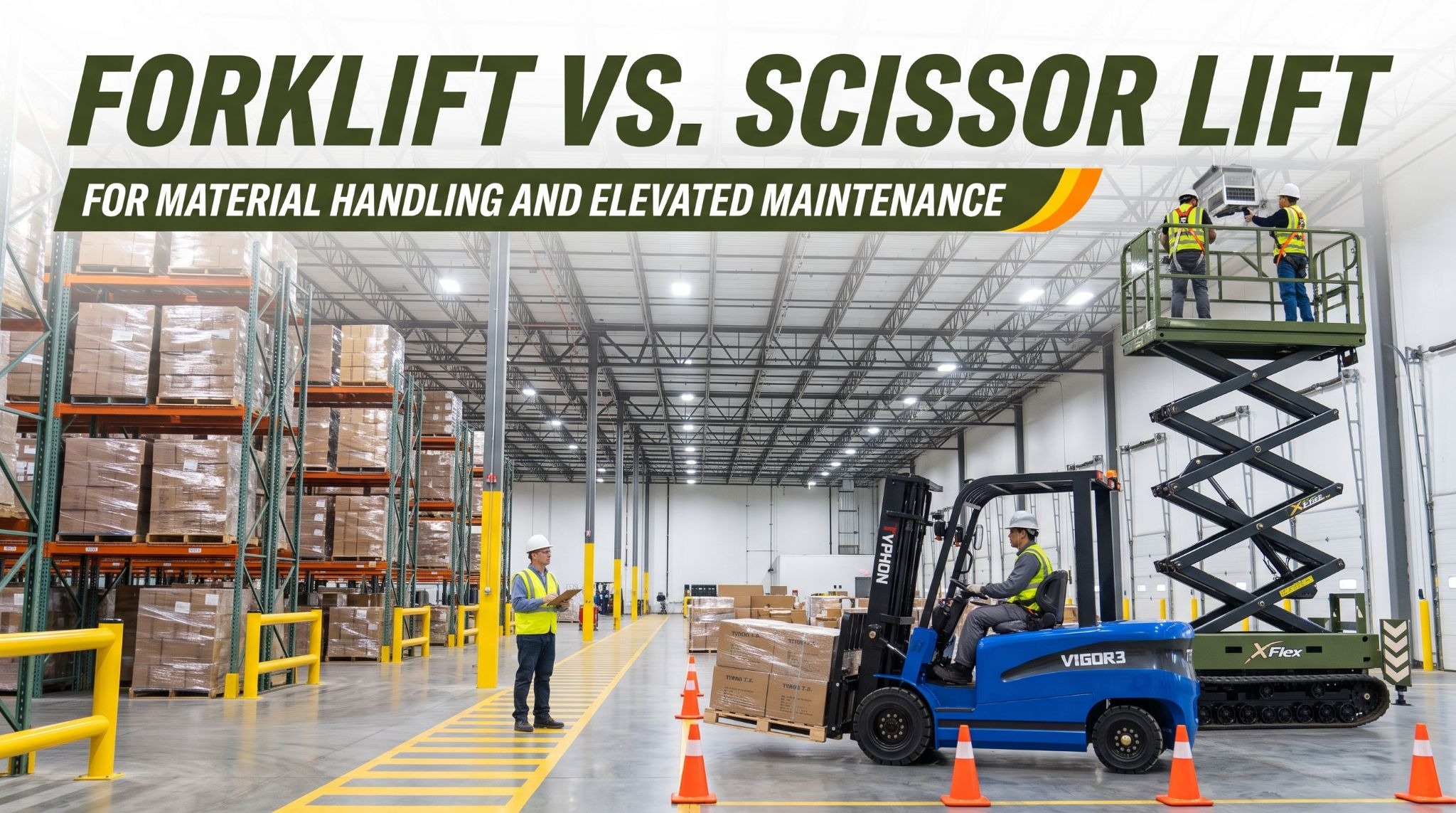
Forklifts and scissor lifts are commonly used in warehouses, manufacturing plants, distribution centers, and construction sites. Although both machines lift materials or workers above ground level, they serve different purposes and have distinct operating capabilities, safety requirements, and load limitations.
Forklifts are designed primarily to lift, transport, and position materials, while scissor lifts provide an elevated work platform for personnel and their tools. Understanding these differences helps businesses select the appropriate equipment for each task, maintain safe working conditions, and avoid unnecessary delays. This article explains how forklifts and scissor lifts differ and how to match each machine to the work it is designed to perform.
Understand the Main Purpose of Each Machine
A forklift is a powered industrial truck designed to lift, transport, and stack loads. It engages a load with forks or a compatible attachment, raises it on a mast, carries it to a new location, and places it on a rack, stack, trailer, or floor. Every part of its design supports that mission. The counterweight balances the load, the mast and carriage raise it, the tilt function stabilizes it, and the overhead guard protects the operator from falling objects. A forklift is a material handling machine first and last.
A scissor lift is a mobile elevating work platform. It raises a guarded platform vertically on a crisscrossed scissor mechanism, giving workers stable access to elevated tasks such as maintenance, installation, inspection, painting, and repair. Its design centers on the people standing on the platform. Guardrails surround the deck, controls on the platform let the occupant raise, lower, and in many cases drive the machine, and tilt sensors, pothole protection, and load sensing help keep the platform stable. The materials a scissor lift carries are the tools and supplies workers need to complete the job at height.
These purposes shape every safety feature on each machine. A forklift’s forks have no guardrails because loads don’t need them. A scissor lift’s platform has no counterweight or tilting mast because it isn’t designed to pick up and carry pallets. When a machine is used outside its purpose, the protective features meant for one job simply don’t exist for the other.
Even with an approved, secured personnel platform, a forklift is a compromise for elevated work. It isn’t designed for repositioning while people are raised, and the operator on the ground controls the movement rather than the worker at height. Many employers prohibit lifting personnel on forklifts entirely and reserve that work for aerial work platforms. Always follow the truck manufacturer’s guidance before considering any personnel platform.
The opposite misuse carries its own risks. A scissor lift isn’t a material hoist or a pallet mover. Loading heavy, bulky materials onto the platform can exceed its rated capacity, shift its center of gravity, overload the deck edges, and block the occupants’ movement inside the guardrails.
Key takeaway: A forklift lifts and moves loads, while a scissor lift raises workers and their tools to elevated tasks. Each machine’s safety features match its purpose, so neither can safely substitute for the other.
Compare Load and Platform Capacity
Both machines carry capacity ratings, and both ratings are expressed in pounds. That’s where the similarity ends. A forklift’s rated capacity and a scissor lift’s platform capacity measure different things under different conditions, and they aren’t interchangeable.
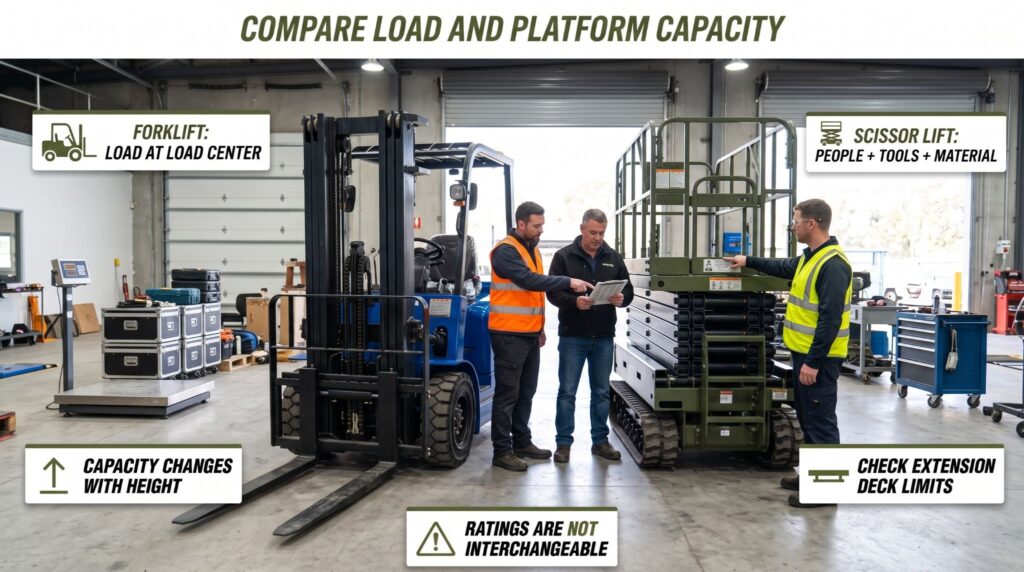
How weight is placed matters on both machines. A forklift load should be centered side to side and pushed back to minimize load center. On a scissor lift, materials should sit inside the guardrails, distributed across the deck rather than concentrated at one edge or on the extension deck. Nothing should extend beyond the rails, and workers should never stand on materials, buckets, or ladders to gain extra height.
Key takeaway: Forklift capacity depends on load weight, load center, lift height, and attachments, while scissor lift platform capacity covers occupants, tools, and materials combined. Check the correct rating for each machine and never treat one as a substitute for the other.
Evaluate Working Height and Reach
Height is often the first figure buyers compare, and it is also one of the most misleading. A forklift and a scissor lift may both list figures around 20 or 30 feet, but those numbers describe different measurements for different purposes. Using the correct measurement for the task prevents costly mismatches.
Forklifts are selected according to the lift height their loads need and the handling those loads require. Maximum fork height describes how high the top of the forks can rise. Mast configuration shapes that figure. Two-stage, three-stage, and four-stage masts reach progressively higher, and the collapsed height of the mast decides whether the truck can pass through doorways, under mezzanines, and into trailers. Free lift, the distance the forks rise before the mast begins to extend, matters when stacking inside trailers or under low ceilings. To size a forklift, start with the height of the highest rack beam or stack level, add clearance for the pallet and load to clear the beam, and confirm the truck’s capacity at that height on the data plate.
Reach differs as well. A scissor lift raises its platform straight up, so it must be positioned close to the work, usually directly beneath or beside it. Many models include an extension deck that slides out several feet to reach over obstacles such as conveyors, equipment, or racking. When the work sits behind or above obstructions that the platform can’t get under or beside, a boom lift or vertical mast lift may be the better choice. Forklift reach is limited to the fork length and any attachment, and reach trucks add pantograph or moving-mast mechanisms designed to place loads deep into racking, not to position people.
Platform size affects productivity on elevated tasks. A narrow platform suits work in tight aisles, while a wider deck gives workers room for tools and materials during installation jobs. Compare platform length, width, and extension deck size with the work you’ll perform, and remember that a larger platform often means a larger, heavier machine.
Key takeaway: Size forklifts by required lift height and capacity at that height, and size scissor lifts by platform height, working height, and platform dimensions. Compare the right measurement for the task, not the machines by height alone.
Consider Facility Layout
A machine that suits the task on paper still has to fit the building. Aisles, floors, doorways, ramps, overhead structures, and pedestrian routes all decide whether a forklift or scissor lift can work efficiently and safely. Walking your facility with each machine’s dimensions in hand is one of the most valuable steps in the selection process.
Scissor lifts also require adequate access, stable flooring, and overhead clearance. Their stowed dimensions matter as much as their raised capabilities. Confirm the machine’s stowed width, length, and height, especially the height with guardrails up. Many models offer fold-down rails that reduce stowed height for passing through doorways and under low ceilings. Check the turning radius and the space needed to position the platform close to the work, including room for an extension deck.
Floors carry both machines, and both concentrate weight. A loaded forklift places heavy loads on its front wheels. A scissor lift can weigh several thousand pounds and concentrates that weight on small wheel contact areas. Concrete slabs in good condition usually handle both. Mezzanines, raised floors, elevated decks, older wood floors, and areas over basements or trenches may not. Check floor load ratings with a qualified engineer before driving either machine onto elevated or suspect surfaces. Look for floor openings, pits, drains, dock edges, and expansion joints along every route, and guard or cover openings that a wheel could drop into.
Indoor air quality affects machine choice too. Internal combustion forklifts and scissor lifts produce exhaust, including carbon monoxide, which can build up in enclosed spaces with limited ventilation. Electric models are often preferred for indoor work in food plants, warehouses, and occupied buildings. Many electric slab scissor lifts are rated for indoor use only, with no wind rating, so confirm the rating before taking any machine outdoors.
Key takeaway: Check aisle widths, turning space, floor and mezzanine ratings, doorways, ramps, overhead clearance, and pedestrian routes for each machine. Confirm stowed dimensions, gradeability, and indoor or outdoor ratings before any machine enters the space.
Review Operator Training and Safety
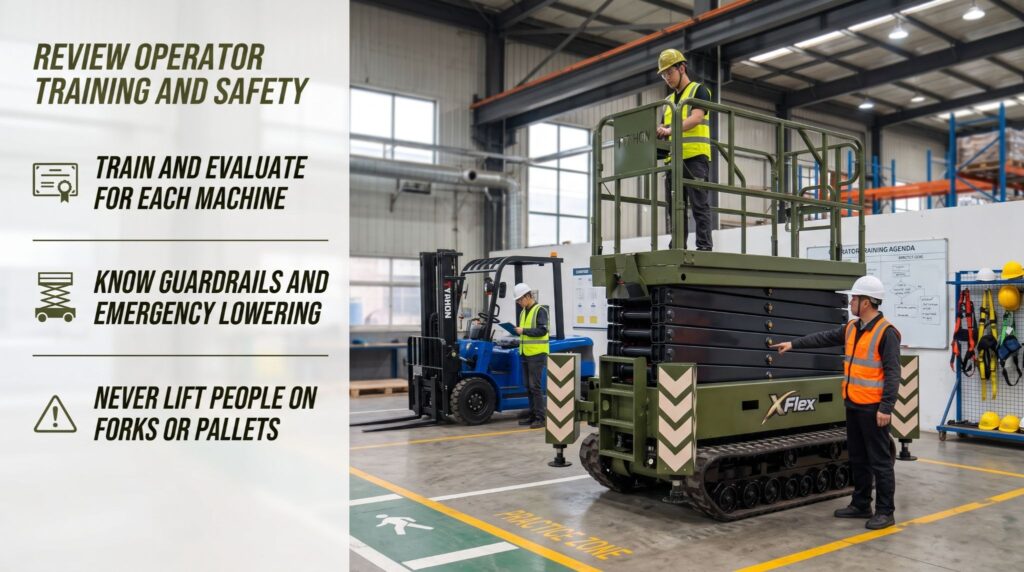
Forklifts and scissor lifts follow separate training requirements, safety rules, and inspection routines. A trained forklift operator isn’t automatically qualified to run a scissor lift, and the reverse is equally true. Building a clear training program for each machine protects workers and keeps your operation in compliance.
Operators must also understand emergency lowering and rescue. Every scissor lift has ground controls and an emergency lowering system, and someone on the ground should know how to use them. Plan rescue procedures before work begins, especially for platforms raised near overhead structures where a worker could be pinned.
Overhead and travel hazards demand constant attention. Before raising, survey the area for beams, ducts, pipes, sprinklers, lights, and electrical lines. Raise slowly near overhead structures, and watch for crushing hazards between the guardrail and the ceiling. Drive with the platform raised only on firm, level surfaces and only when the manufacturer permits it. Use pothole protection, tilt alarms, and other safety devices exactly as designed, and never disable them.
Both machines require clear separation from pedestrians, good housekeeping, and documented inspections. Follow applicable workplace regulations, manufacturer manuals, and your company’s written procedures, and keep training records current for every operator.
Select Equipment for the Actual Task
The right choice starts with a clear description of the work. Ask what is moving and where it needs to go. If the answer is a load, a forklift is the starting point. If the answer is a person who needs to work at height, an aerial work platform is the starting point. Many facilities need both, and the most productive operations plan for both from the outset.
Use a forklift when the job involves moving or stacking goods. Receiving pallets from trailers, putting inventory into racks, staging materials for production, loading finished goods, and moving heavy components around a plant are all forklift tasks. Choose the truck class, mast, capacity, and attachments based on your heaviest regular loads, their dimensions, the highest storage level, aisle widths, floor surfaces, and indoor or outdoor use. Confirm capacity at the required lift height and load center for every attachment you plan to use.
Use a scissor lift when workers need a stable elevated platform for approved maintenance or installation work. Replacing light fixtures, servicing HVAC units, installing sprinkler lines, running cable tray, painting, hanging signage, inspecting overhead structures, and repairing ductwork are all scissor lift tasks. Choose the model based on the task height and working height, platform capacity for the occupants, tools, and materials involved, platform size, stowed dimensions, floor conditions, and indoor or outdoor rating.
Some tasks need both machines working together. In the opening scenario, the best plan would have used a forklift to stage cases of fixtures on the floor near each work area. Electricians on a scissor lift could then carry up only the fixtures and tools needed for each installation, staying within platform capacity on every trip. Coordinating the two machines this way keeps materials moving and keeps workers safely elevated. When both machines work in the same area, establish clear zones so forklifts don’t travel beneath or strike a raised platform.
Plan the decision around how often each task occurs. Equipment used every day, such as forklifts in a busy warehouse, usually justifies ownership. Elevated maintenance that happens a few times a year may be better served by rental, provided rentals are scheduled early enough to avoid the delays that tempt crews to improvise. Build equipment needs into maintenance planning, shutdown schedules, and project timelines, so the right machine is on site before work begins.
Make the decision a policy, not a judgment call made under pressure. Write clear rules stating which machines may be used for which tasks, prohibit standing on forks or pallets, and require a supervisor’s approval before any change in equipment. Train every supervisor and lead to recognize when a task calls for an aerial work platform. When the right machine isn’t available, the safe answer is to wait, reschedule, or rent, not to improvise.
Key takeaway: Use a forklift to move and stack goods, use a scissor lift to give workers a stable elevated platform, and coordinate both when a task needs materials staged and work done at height. Set written rules so crews never improvise with the wrong machine.
Conclusion
Forklifts and scissor lifts both raise loads, but they serve different industrial purposes. Forklifts move and stack materials, with lifting capacity affected by load weight, load center, lift height, and attachments. Scissor lifts raise workers and their tools on guarded platforms, with capacity based on the combined weight of occupants, equipment, and materials.Using either machine outside its intended purpose can create serious safety risks. Evaluate your facility’s material-handling and elevated-work tasks by considering required heights, loads, frequency, and locations. Check aisle widths, doorways, overhead clearances, and floor ratings to identify suitable models. Keep training current and establish clear rules against using forklift forks or loose pallets to lift people. Matching each machine to its intended task helps improve material handling, support safe overhead work, and keep operations running efficiently.
Frequently Asked Questions
Can a scissor lift move pallets?
It is not designed to replace a forklift for pallet transport or stacking. A scissor lift’s platform capacity covers occupants, tools, and materials combined, and heavy or bulky loads can exceed that rating, shift the center of gravity, and crowd workers inside the guardrails. Use a forklift to stage materials near the work, then carry only what’s needed onto the platform within its rated capacity.
Are their capacity ratings comparable?
No. Forklift load capacity and scissor lift platform capacity measure different things. Forklift capacity depends on load weight, load center, lift height, mast configuration, and attachments. Scissor lift platform capacity is the combined weight of occupants, tools, and materials on the deck, often with separate limits for the extension deck and for indoor and outdoor use.
Which machine is better for warehouse maintenance?
A scissor lift is generally suited to elevated maintenance, while a forklift handles materials. Tasks such as replacing lights, servicing HVAC units, and repairing sprinklers need a stable, guarded platform for workers. Many maintenance jobs work best with both machines, using a forklift to stage materials and a scissor lift to give workers safe access at height.