Currently Empty: $0.00
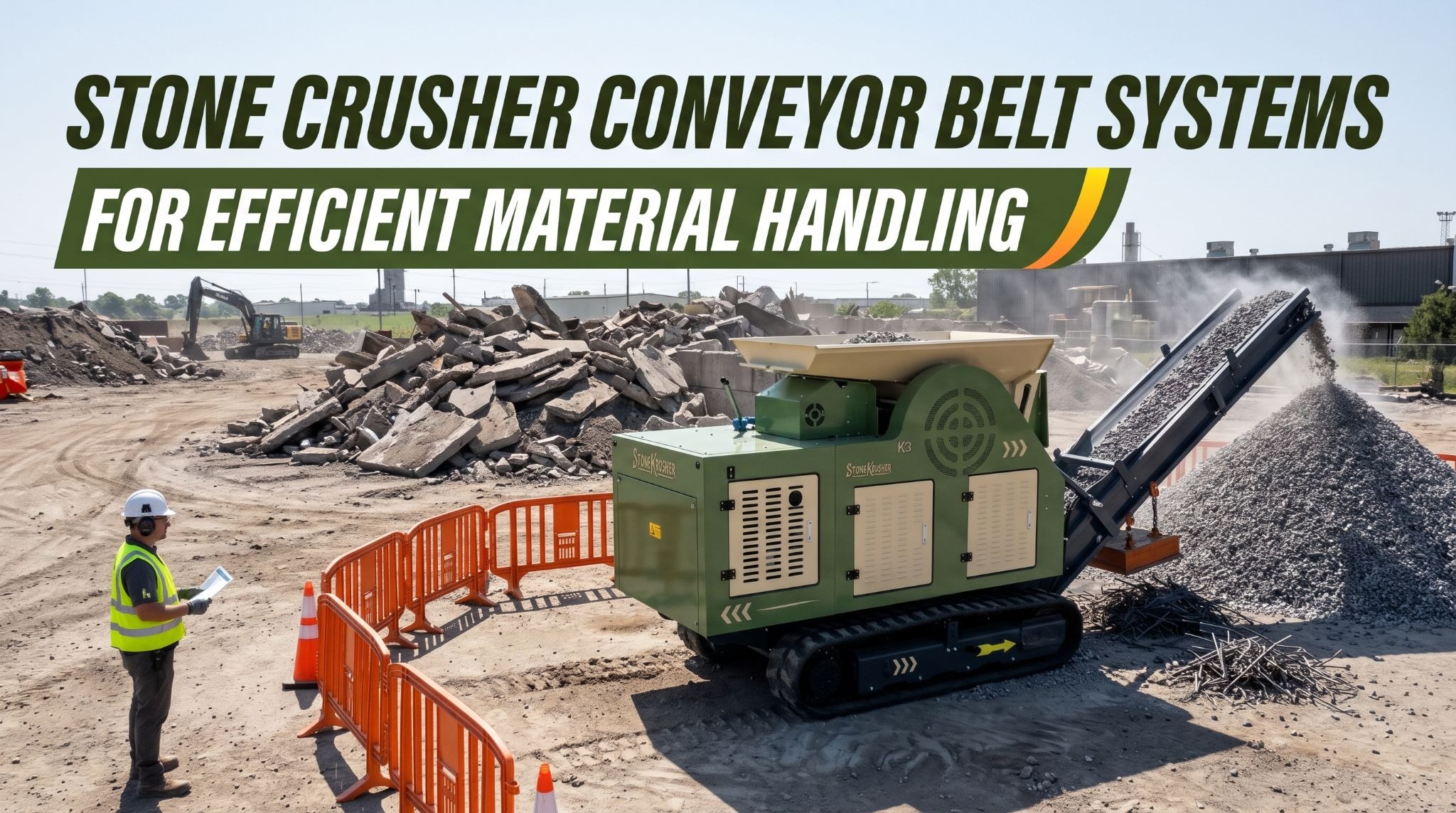
Stone Crusher Conveyor Belt Systems for Efficient Material Handling
A demolition contractor sets up a compact tracked jaw crusher to turn old parking lot concrete into base material for a new retail pad. The crusher runs well, but the discharge conveyor wasn’t sized or adjusted for the job. Within the first hour, the belt drifts to one side, crushed concrete spills over the edge, and a short stockpile builds up until it touches the head pulley. By midday, rebar fragments have sliced the belt cover, the crew has stopped twice to shovel spillage from under the return idlers, and production sits at half the planned tonnage.
Conveyor belt systems move crushed material away from a stone crusher and keep the production area organized. On a mobile or compact crushing plant, the main discharge conveyor carries the crusher’s full output to a stockpile, a screening unit, or the next processing stage. Side conveyors may carry fines, sized products, or bypass material. When these conveyors are well matched to the crusher and properly maintained, material flows steadily, stockpiles form cleanly, and loaders spend less time re-handling aggregate. When they aren’t, the conveyor becomes the bottleneck that limits the whole operation.
Conveyor design affects far more than transport. Belt width, length, speed, troughing, and discharge height decide how much material the conveyor can carry, how high stockpiles can rise, and how much spillage the crew must clean up. Belt tracking and component condition decide whether the system runs all day or stops for repairs. Conveyors also bring some of the most serious hazards on any crushing site, from nip points to unexpected startup during maintenance. This guide explains how to evaluate each factor so you can choose, set up, and run a conveyor system that supports efficient, safe aggregate production.
Understand the Conveyor’s Role
A conveyor transfers material from the crusher discharge area to a stockpile, a screening system, or another processing stage. On a typical mobile jaw crusher, rock passes from the hopper and vibrating feeder into the crushing chamber. It drops through the closed side setting onto the main conveyor beneath the jaws. That conveyor carries the crushed product up and away from the machine, discharging it into a pile or onto a second conveyor. On impact and cone crushers, the arrangement is similar, though the chamber design and product shape differ.
Continuous removal is the conveyor’s most important job. A crusher can only keep producing if material leaves the discharge zone as fast as it arrives. If the conveyor slows, stalls, or overloads, crushed material backs up beneath the chamber. In a jaw crusher, that backup can pack the discharge area, increase load on the jaws and bearings, and eventually stop the machine. The conveyor isn’t an accessory to the crusher. It is a working part of the production system, and its capacity sets an upper limit on what the plant can deliver.
Many crushing plants use more than one conveyor. A side conveyor may carry fines or soil removed at the grizzly before they reach the chamber. That keeps them out of the finished product and reduces wear on crushing surfaces. Plants with an onboard screen often use additional conveyors to separate sized products into different piles and return oversize for recrushing. Stockpiling conveyors, sometimes called stackers, may extend discharge height and reach so the plant can build larger piles. Each conveyor in the chain must match the flow it receives, since a single undersized belt limits everything upstream.
The conveyor also handles material that doesn’t belong in the product. Recycled concrete often contains rebar and wire mesh. Many plants fit an overband magnet above the main conveyor to lift steel off the belt and drop it into a separate pile. Wood, plastic, and other debris that pass through the crusher may need picking or separation along the conveyor. Planning for these materials protects the belt from cuts and keeps the finished aggregate within specification.
Key takeaway: The conveyor carries the crusher’s full output away from the discharge zone, so its capacity and reliability set a firm limit on plant production. Plan every conveyor in the system to match the flow it receives.
Inspect Belt Tracking and Components
A conveyor only runs efficiently when the belt tracks straight and every component works as designed. Misalignment, incorrect tension, and worn parts cause uneven wear, spillage, belt damage, and unplanned downtime. Regular inspection catches these problems early, and most take only minutes to check during the pre-shift walk-around.
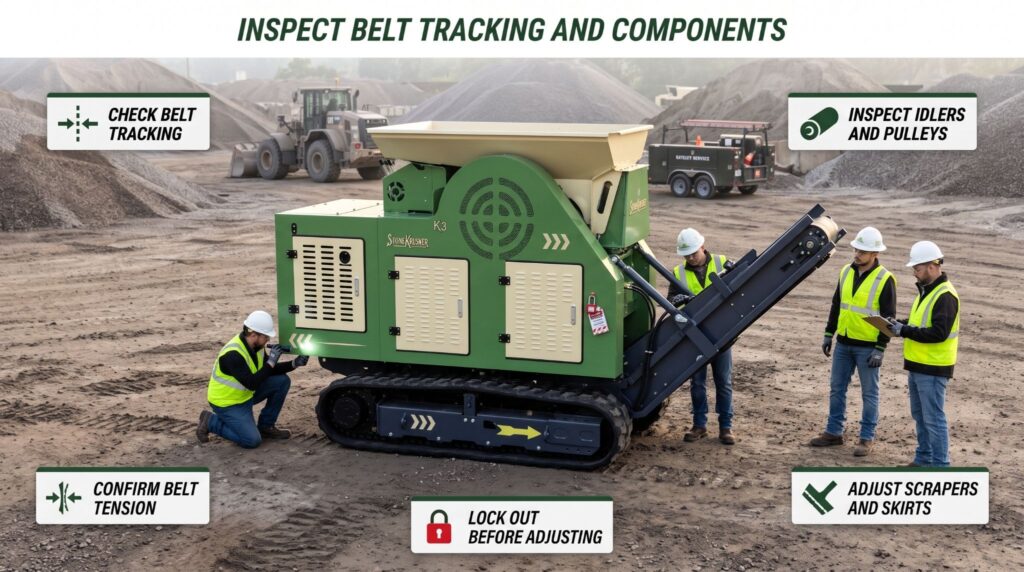
Belt tracking comes first. A belt that drifts to one side rubs against the frame, wears its edges, and spills material over the low side. Common causes include uneven loading, idlers or pulleys out of square with the frame, worn or seized idlers, material buildup on rollers and pulleys, incorrect tension, and a poorly made splice. A belt also tends to move toward the end of a roller it contacts first. That principle explains why a skewed idler steers the belt one way or the other. Many conveyors use training idlers to help correct small drift. Follow the manufacturer’s procedure for adjustments, make small changes one at a time, and observe the result over several full belt revolutions. Always make adjustments with the conveyor stopped and locked out, as Section 6 explains.
Inspect the idlers and pulleys closely. Seized or worn idlers create friction, heat, and belt wear, and a seized roller can wear flat or sharp and cut the belt. Listen for squealing or grinding, and look for rollers that don’t turn, have flat spots, or show worn shells. Check pulleys for buildup, worn lagging, and damaged bearings. Look at the impact bed or impact idlers beneath the loading zone. These absorb the force of material falling from the crusher, and worn impact components let the belt sag and spill material.
Belt tension and condition need regular attention. A belt that is too loose slips on the drive pulley, sags between idlers, and spills material. A belt that is too tight stresses the splice, bearings, and pulleys. Check tension using the manufacturer’s method, whether a screw take-up or another system. Inspect the belt surface for cuts, gouges, tears, edge damage, and exposed fabric or cords. Rebar and sharp concrete fragments are common causes of damage on recycling jobs. Check every splice for lifting fasteners or separation, since a failing splice can tear apart under load.
Scrapers and skirting control carryback and spillage. Belt scrapers at the head pulley remove material that clings to the belt after discharge. Without them, that material falls off along the return run, building up under the conveyor and on idlers. Check scraper blades for wear and correct contact pressure. Skirt boards and seals along the loading zone keep material on the belt as it lands. Inspect them for gaps, wear, and correct adjustment, without excessive pressure that wears the belt surface. Confirm that all protective guards are present and secure.
Key takeaway: Check belt tracking, idlers, pulleys, impact components, tension, splices, scrapers, skirting, and guards before every shift. Correct misalignment with small, manufacturer-approved adjustments made only while the conveyor is stopped and locked out.
Compare Belt Width and Length
Belt width and length decide how much material a conveyor can carry and where it can deliver it. Width controls the cross-sectional area of material on the belt and the size of lumps it can handle. Length, combined with incline angle, controls discharge height and reach. Both must suit the crusher’s rated output and the space available on site.
Site space shapes the decision as well. A long conveyor needs room at the discharge end for the stockpile and for a loader to work around it safely. It also needs clearance from overhead power lines, structures, and haul routes. Many mobile crushers use hydraulic folding conveyors that shorten for transport and extend for work. Confirm both the transport dimensions and the working length, and check whether the conveyor can operate at intermediate angles on sites with limited overhead clearance.
Compare width and length against the crusher’s rated output and your typical layouts. Request conveyor dimensions, maximum incline, and recommended material types in writing for the exact configuration you plan to run. A conveyor that fits the crusher on paper but forces the stockpile into a cramped corner will cost time every day the plant runs.
Key takeaway: Choose belt width to suit the crusher’s output and largest product size, and choose length and incline to deliver the discharge height and reach your site layout needs, within the manufacturer’s limits.
Review Conveyor Speed and Capacity
Conveyor capacity depends on three connected factors: the cross-sectional area of material on the belt, the belt speed, and the material’s bulk density. Multiply those together and you get the weight of material the conveyor can move per minute or hour. Each factor has limits, and the conveyor must handle the crusher’s expected discharge rate without spillage or buildup.
A simple illustration shows how the factors combine. Suppose the loaded cross-section of material on a troughed belt is 0.25 square feet, the belt runs at 300 feet per minute, and the crushed stone weighs about 100 pounds per cubic foot. The conveyor moves 0.25 × 300 × 100 = 7,500 pounds per minute, or roughly 225 short tons per hour. Change any one factor and capacity changes in proportion. Real figures depend on belt width, idler design, material behavior, and the manufacturer’s rating method, so treat this as an example of the relationship rather than a sizing rule.
Troughing has a major effect on cross-sectional areas. Most crusher conveyors use troughing idlers that raise the belt edges into a shallow U shape, commonly at angles such as 20, 35, or 45 degrees. A deeper trough holds more material and keeps it centered. The material’s surcharge angle, the slope it forms on a moving belt, also affects how high the load can rise above the belt edges. Fine, dry material spreads flatter, while angular crushed stone holds a higher profile.
Belt speed involves trade-offs. A faster belt carries more material, but it also throws material farther at the discharge, increases wear on the belt and idlers, and can create more dust and spillage at transfer points. Very high speeds can make it harder to load the belt smoothly beneath the crusher. A slower belt runs more gently but may overload if crusher output rises. On most mobile plants, the manufacturer sets the conveyor speed and drive to suit the crusher. Some machines allow speed adjustment through hydraulic drives. Follow the manufacturer’s recommended range rather than adjusting speed by feel.
Compare conveyor capacity with the crusher’s actual operating conditions. Crusher output varies with feed size, rock hardness, closed side setting, and feeding consistency. Surges are common when a large bucket of material enters the hopper. The conveyor needs enough margin to absorb those surges without overloading. Confirm whether capacity figures are stated in short tons or metric tonnes, and at what material density. Watch for signs of overload, such as material spilling at the loading zone, load riding up to the belt edges, or the drive slowing under load.
Key takeaway: Conveyor capacity depends on loaded cross-section, belt speed, and material density. Confirm that the conveyor can carry the crusher’s peak discharge rate with margin, and keep speed within the manufacturer’s recommended range.
Consider Discharge and Stockpile Height
Discharge height determines where crushed material can be deposited and how large a stockpile can grow before it reaches the conveyor. It has a direct effect on how often a loader must move material, how much site space the operation needs, and how evenly the finished product stays graded.
Stockpile volume grows rapidly with height. A conical pile of crushed stone forms at its angle of repose, often somewhere around 35 to 40 degrees depending on material shape and moisture. Because the pile’s radius grows with its height, volume increases with the cube of height. At an angle of repose of about 37 degrees, a 12-foot-high cone holds roughly 118 cubic yards. An 18-foot-high cone holds roughly 400 cubic yards, more than three times as much for only 50 percent more height. That difference decides whether a loader must clear the pile every hour or only a few times per shift.
Higher discharge brings its own considerations. Material dropping from greater height can segregate, with larger pieces rolling to the outside of the pile and fines collecting in the center. On graded products such as road base, segregation can cause problems in placement and testing. Wind can also carry fines and dust from a high discharge point. Some operations manage segregation by building piles in layers, moving the discharge point, or using stacking conveyors that adjust height as the pile grows. Dust control at the discharge, such as water spray, also helps keep fines in the product.
The stockpile must never reach the conveyor head. When the pile builds up against the discharge pulley, material backs up onto the belt, overloads the drive, and can damage the belt and pulley. It also forces the crusher to stop. Plan loader cycles so the pile is cleared before it gets close. Mark a safe working distance around the discharge end, and keep the loader operator in clear view of the conveyor operator. Loader operators should approach the pile from the side away from the conveyor wherever possible and never undermine the face of a tall pile.
Check both transport and operating configurations. Many folding conveyors offer more than one working angle, and some extend in length. Confirm the discharge height at each setting, the overhead clearance required, and the ground area the stockpile will need. A suitable conveyor arrangement creates organized stockpiles, reduces extra loading movements, and keeps finished product separate from feed and waste.
Key takeaway: Higher discharge builds much larger stockpiles and reduces loader work, but it can increase segregation and dust. Clear piles before they reach the head pulley, and confirm discharge height for each working configuration.
Maintain Safe Material Handling
Conveyors are among the most hazardous parts of any crushing operation. A moving belt pulls anything that touches it toward pulleys, idlers, and drives with enough force to cause amputations and fatal injuries. Nip points form wherever the belt meets a pulley or roller. Falling material, unexpected startup, and stored energy in tensioned belts add further risks. Safe conveyor practice protects every person who works on or near the plant.
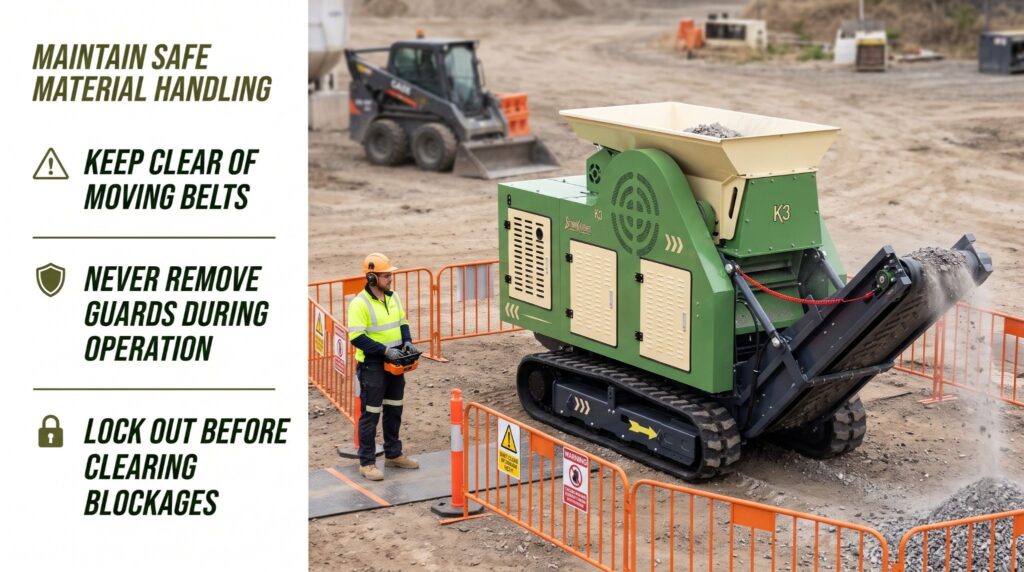
Training ties these practices together. Every operator and crew member should understand where the stops and pull cords are, how lockout works on your specific plant, and which areas are off-limits during operation. Brief the crew on the plant layout, conveyor hazards, and emergency procedures at the start of each shift. Update the briefing as the site changes. Keep inspection and lockout records, and tag out any conveyor with a damaged guard, faulty stop, or failing component until a qualified technician completes the repair.
Key takeaway: Keep people clear of moving belts and nip points, keep every guard in place, test stops before each shift, and always lock out and verify isolation before clearing material or performing maintenance.
Conclusion
A properly matched conveyor belt system moves material away from the crusher continuously, supports steady production, and keeps the worksite organized. Its capacity must handle the crusher’s full output to prevent material buildup and production delays. Belt width and length should match the product size, processing volume, and site layout. Belt speed, troughing, and material density affect throughput, while discharge height influences stockpile size and loader workload. Regular attention to belt tracking, idlers, tension, scrapers, and guards helps maintain reliable operation. Compare conveyor width, length, incline, speed, capacity, and discharge height with the crusher’s peak output and typical site requirements. Request written specifications for the exact configuration, and include belt tracking, component condition, and guard inspections in every pre-shift check. Train all crew members to use emergency stops and follow lockout procedures. Proper selection, maintenance, and safety practices support consistent aggregate production while protecting equipment and workers.
Frequently Asked Questions
Why does a stone crusher need a conveyor?
It moves crushed material away from the discharge area to a stockpile, screen, or further processing stage. Continuous removal prevents material from backing up beneath the crushing chamber, which would overload the crusher and stop production.
Does conveyor capacity need to match crusher output?
Yes. The conveyor should carry the crusher’s expected discharge rate with enough margin to absorb surges from uneven feeding. An undersized conveyor spills material, overloads its drive, and limits the output of the entire plant.
What causes conveyor belt misalignment?
Common causes include uneven or off-center loading, incorrect tension, worn or seized idlers, idlers and pulleys out of square, material buildup on rollers and pulleys, and poorly made splices. Correct the cause with small, manufacturer-approved adjustments made only while the conveyor is locked out.
Can blockages be cleared while the conveyor is running?
No. Stop the crusher and conveyor, apply lockout and tags, release or secure stored energy, and verify the machine can’t start before clearing material. Clearing a running conveyor exposes workers to nip points that can cause severe or fatal injuries.