Currently Empty: $0.00

How Hydraulic Flow Affects Mobile Crane Operating Speed
Speed matters on any lift job, and for a mobile crane, that speed comes down to hydraulics. Hydraulic flow is the volume of fluid the system moves to the cylinders and motors that raise the boom, extend the sections, and swing the load. When flow is generous and well matched, the crane responds quickly and cycles feel productive. When it falls short, every movement drags, and the operator waits on a machine that should be working. Understanding how hydraulic flow shapes operating speed helps you judge a crane by what it actually does on site. This guide explains how flow drives crane movement, why pump flow rate matters, and how the best systems balance speed with the smooth control that safe lifting demands.
How Hydraulic Flow Determines Crane Movement Speed
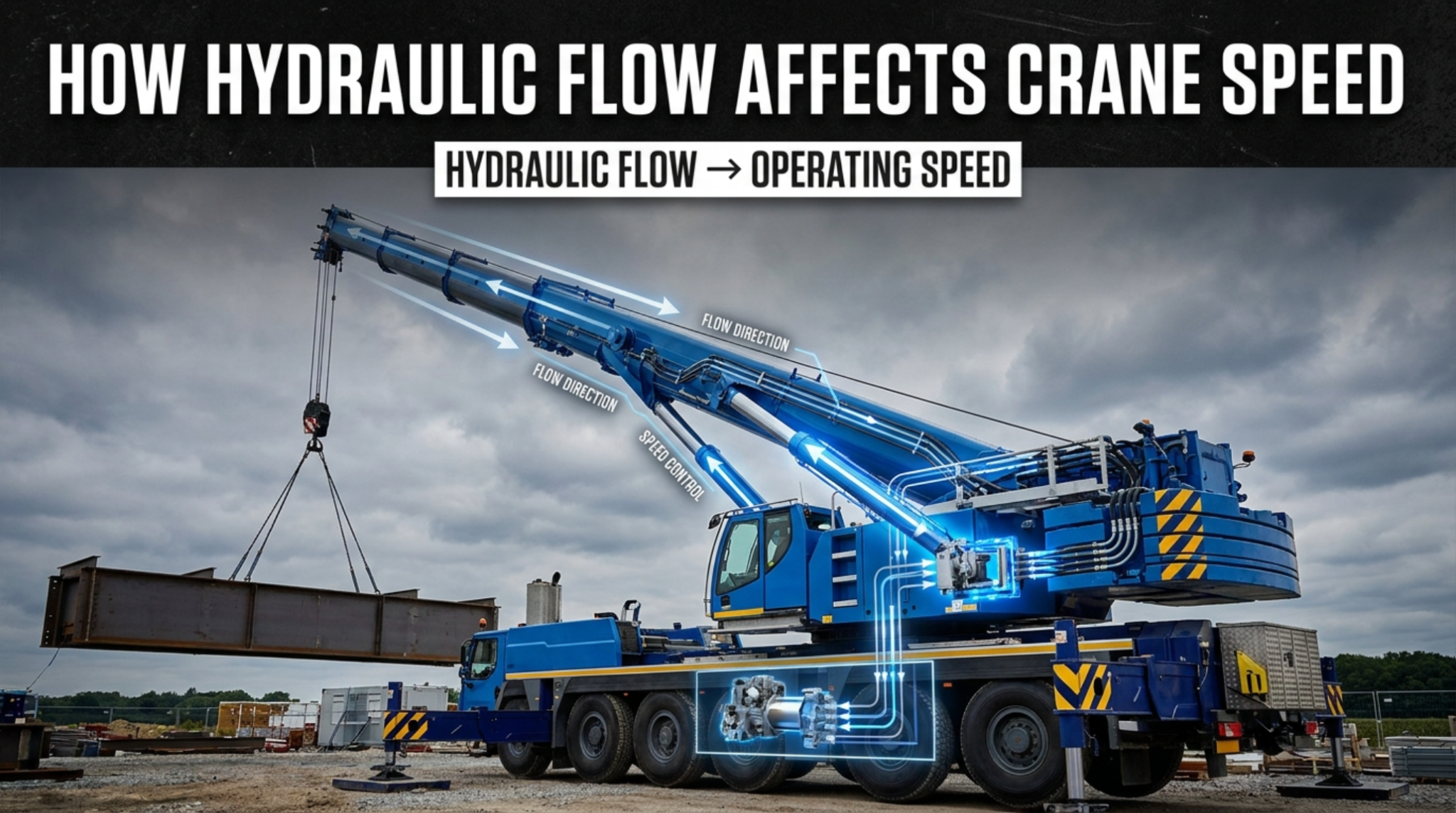
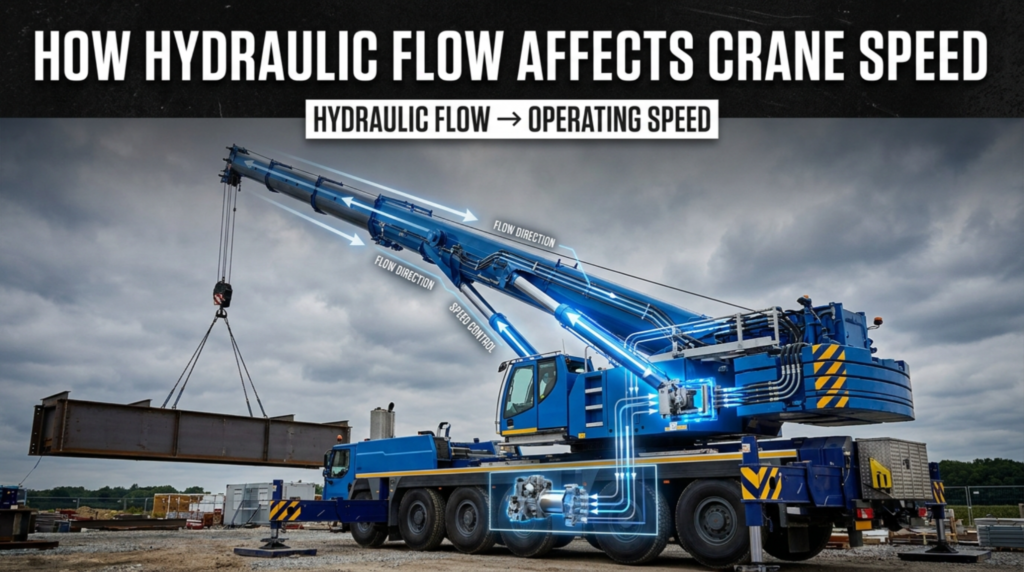
Hydraulic flow is the single factor that most directly governs how fast a mobile crane moves. Flow describes the volume of hydraulic fluid delivered to the crane’s cylinders and motors over a given time, usually measured in gallons or liters per minute. The faster that fluid arrives at a component, the faster that component moves. When the boom raises, the telescoping sections extend, or the crane swings, each of those functions depends on receiving enough fluid to move at a useful pace. Higher flow feeds them more quickly, so movements happen faster and cycles finish sooner.
The connection is straightforward in practice. A hydraulic cylinder extends as fluid fills it, and the rate at which the fluid enters sets the rate at which the cylinder moves. Supply plenty of flow, and the cylinder strokes quickly. Restrict that flow, and the same cylinder crawls through its motion. This holds true across every hydraulic function on the crane, which is why flow has such a broad effect on overall speed.
Too little flow makes an operation feel slow and less productive. Consider where that shows up:
- Boom movements take longer to reach position, stretching out each lift cycle.
- Telescoping sections extend and retract sluggishly, delaying setup at the required reach.
- Swing and other functions respond lazily, adding time to every stage of the work.
A crane with adequate hydraulic flow moves with purpose, completing lifts efficiently and keeping the job on schedule. Flow is not the only factor in performance, but it is the one that most clearly sets the pace of movement, which makes it central to how productive the crane feels in daily use.
Why Hydraulic Pump Flow Rate Matters
The hydraulic pump is the heart of the system, and its flow rate determines how much fluid the crane has to work with. The pump draws fluid from the reservoir and delivers it under pressure to the components that need it, and the volume it can deliver sets the ceiling on how fast those components can move. A pump with a flow rate matched to the crane’s demands supplies enough fluid to keep every function responsive, while an undersized pump leaves the system starved and the movements slow.
Flow rate matters because it defines the crane’s potential speed before any other factor comes into play. You cannot move a cylinder faster than the fluid arriving at it allows, so the pump effectively caps how quickly the crane can perform. A well-sized pump gives the operator the fluid needed for brisk, responsive movement, letting the crane keep pace with the demands of the job rather than lagging behind them.
At the same time, the right pump flow rate is about more than raw volume. It has to deliver responsive movement without sacrificing the smooth control that safe crane work depends on. A pump matched to the machine supplies fluid steadily and predictably, so the operator gets quick response and fine control together rather than one at the expense of the other. This balance is what separates a crane that simply moves fast from one that moves fast and remains easy to handle.
When you evaluate a mobile crane, the pump’s flow rate deserves close attention, because it shapes the responsiveness you will feel in every function. A pump sized correctly for the crane’s cylinders, motors, and typical work delivers the fluid the system needs to perform quickly and controllably, which is the foundation of dependable, productive operation on every lift.
How Flow Affects Boom Raising and Lowering
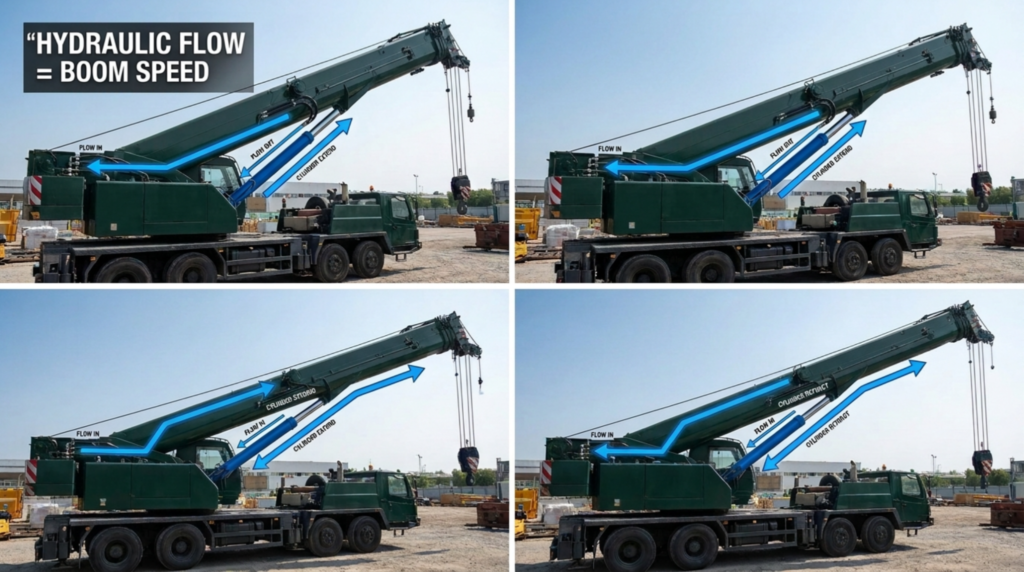
Raising and lowering the boom is one of the most frequent movements a mobile crane makes, and hydraulic flow governs how quickly it happens. The boom is raised and lowered by hydraulic cylinders, and those cylinders move as fluid fills or drains from them. The amount of hydraulic oil reaching the cylinders directly sets the speed of the motion. Supply sufficient flow, and the boom lifts and lowers briskly. Restrict that flow, and each movement takes noticeably longer, adding time to every positioning task.
This matters because boom positioning happens constantly throughout a lift. The operator raises the boom to reach height, adjusts it to place a load, and lowers it to return for the next pick. Each of these actions depends on the cylinders receiving enough oil to move at a useful pace. When flow is adequate, the boom responds promptly to the operator’s input, and the crane works through its cycles efficiently. When flow is restricted, the boom becomes the bottleneck, and the whole operation slows to the pace of its sluggish movement.
The effect is easy to picture in daily work. A crane placing loads repeatedly, such as feeding materials to a structure or setting components in sequence, relies on quick boom movement to keep the cycle short. If the boom takes longer than it should to raise and lower, every cycle stretches out, and productivity across the shift suffers. Multiply that delay across a full day of lifts, and the lost time becomes significant.
Adequate hydraulic flow keeps boom positioning quick and responsive, letting the operator work smoothly through each lift. Because boom raising and lowering is so central to how a crane operates, ensuring the cylinders receive the flow they need is essential to keeping the machine productive and the job moving on schedule.
How Hydraulic Flow Influences Telescoping Speed
Telescopic boom sections give a mobile crane its reach, and hydraulic flow controls how quickly those sections extend and retract. The telescoping sections rely on hydraulic power to slide in and out, driven by cylinders that move as fluid fills them. The available flow rate directly affects how fast the sections travel to the desired reach. With ample flow, the boom telescopes out and in quickly, letting the operator reach the working length without delay. With restricted flow, extending and retracting becomes a slow process that holds up the setup.
Telescoping speed matters most during the positioning phase of a lift, when the operator sets the boom to the reach the job requires. Getting to that length quickly means less waiting before the actual work begins, and it means faster adjustments when the reach needs to change between lifts. A crane that telescopes briskly keeps setup efficient, while one that extends sluggishly forces the operator and crew to wait through each change in length.
The demands on flow can be considerable here, since telescoping often involves moving long, heavy boom sections over a significant distance. Consider what adequate flow supports:
- Quick extension to reach the required working length without unnecessary waiting.
- Fast retraction when repositioning the crane or preparing for transport.
- Responsive adjustment when the reach needs fine-tuning between picks.
Because telescoping moves the boom through a long stroke, the volume of fluid required is substantial, and insufficient flow shows up clearly as slow, drawn-out movement. A crane with hydraulic flow matched to its telescoping demands positions its boom quickly and keeps the operation moving. When you assess a mobile crane’s speed, telescoping performance is a telling indicator, because it depends so directly on the flow the system can deliver to those long-travel cylinders.
Balancing Hydraulic Flow With Smooth Crane Control
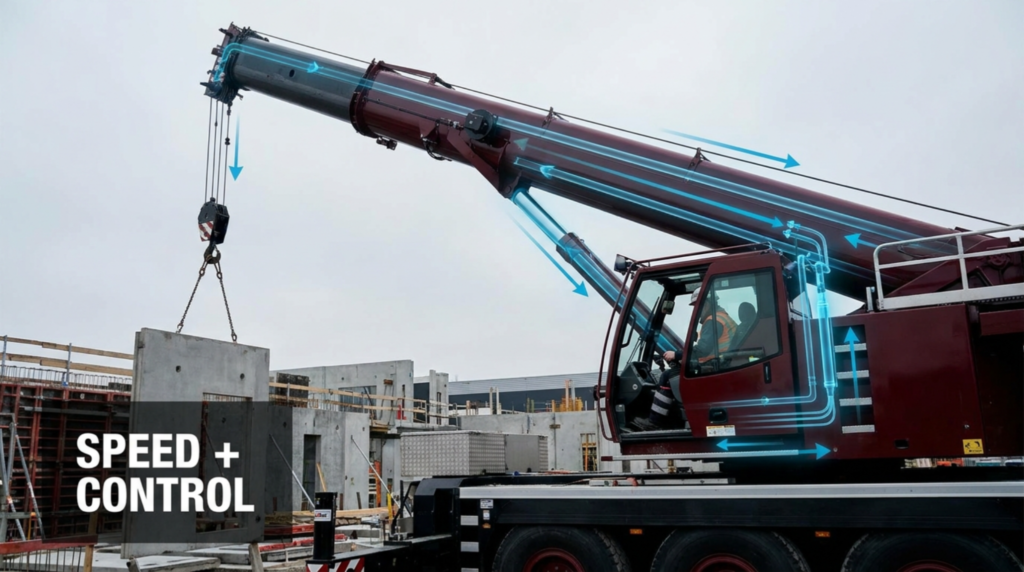
It is tempting to assume that more hydraulic flow always means better performance, but crane operation tells a more nuanced story. Maximum flow does not automatically produce a better machine. A crane that moves quickly but abruptly can be difficult and even unsafe to handle, especially when precision matters most. The best hydraulic systems balance flow with pressure, component capacity, and operator control, delivering fast movements that remain smooth and manageable throughout every lift.
The reason balance matters comes down to the nature of crane work. Lifting demands both speed and precision, and those two qualities can pull against each other if the system is not well designed. Excessive flow can make movements feel jumpy or hard to modulate, which is a serious concern when an operator is placing a heavy load with care. Flow has to work in concert with the rest of the system so the crane responds quickly to bold inputs yet moves gently when the operator eases off.
Several elements must work together to strike this balance:
- Flow and pressure combine so the crane has both the speed of movement and the force to handle its loads.
- Component capacity ensures the cylinders, valves, and motors can handle the flow without strain or erratic motion.
- Operator control stays precise, letting the operator feather movements for delicate positioning.
A well-engineered system gives the operator responsive speed when the work calls for it and fine, controllable movement when precision is essential. This is what allows a crane to work quickly through its cycles while still placing loads safely and accurately. Rather than chasing the highest flow figure, look at how the whole hydraulic system is balanced. A crane that pairs strong flow with smooth control delivers the productive speed and the confident handling that dependable lifting requires on every job.
Conclusion
Hydraulic flow sits at the center of how fast and how well a mobile crane performs. It sets the speed of boom raising and lowering, drives how quickly the telescoping sections reach their working length, and governs the responsiveness of every hydraulic function on the machine. The pump’s flow rate defines the crane’s potential speed, supplying the fluid that keeps movements brisk and productive. Yet raw flow is only half the story, because the best cranes balance flow with pressure, component capacity, and precise operator control to deliver speed that stays smooth and safe. When you judge a mobile crane’s operating speed, look past a single number and consider how the whole hydraulic system is engineered to work together. That balance is what delivers the responsive, controllable performance you can rely on lift after lift.
Frequently Asked Questions
1. What is hydraulic flow and how does it affect a mobile crane’s speed?
Hydraulic flow is the volume of fluid the system delivers to the crane’s cylinders and motors over a given time, usually measured in gallons or liters per minute. It affects speed directly because a hydraulic cylinder moves as fluid fills it, and the rate at which fluid arrives sets the rate at which the cylinder strokes. Higher flow feeds the components more quickly, so the boom raises, the section’s telescope, and the crane swings faster. Too little flow makes these movements sluggish and the operation less productive. Because flow influences every hydraulic function, it is the factor that most clearly sets the pace of the machine.
2. Why does the hydraulic pump’s flow rate matter so much?
The pump draws fluid from the reservoir and delivers it under pressure to the components, so its flow rate sets the ceiling on how fast the crane can move. You cannot move a cylinder faster than the fluid arriving at it allows, which means the pump effectively caps the crane’s potential speed. A pump with a flow rate matched to the machine’s demands supplies enough fluid to keep every function responsive, while an undersized pump leaves the system starved and the movements slow. The right pump also delivers fluid steadily, so the operator gets quick response and fine control together rather than one at the expense of the other.
3. How does hydraulic flow affect boom raising and lowering?
The boom is raised and lowered by hydraulic cylinders that move as fluid fills or drains from them, so the amount of oil reaching those cylinders directly sets the speed of the motion. Sufficient flow lets the boom lift and lower briskly, while restricted flow makes each movement take noticeably longer. This matters because boom positioning happens constantly throughout a lift, as the operator raises the boom to height, adjusts to place a load, and lowers it for the next pick. When flow is adequate, the boom responds promptly and cycles stay short. When it is restricted, the boom becomes a bottleneck that slows the whole operation.
4. Does hydraulic flow influence how fast the boom telescopes?
Yes. The telescopic sections extend and retract using hydraulic cylinders, and the available flow rate directly determines how quickly they travel to the desired reach. Ample flow lets the boom telescope out and in quickly, so the operator reaches the working length without delay and can adjust reach efficiently between lifts. Restricted flow makes extending and retracting slow, which holds up setup. The demands here are considerable, because telescoping moves long, heavy boom sections over a significant distance, so the volume of fluid required is substantial. Insufficient flow shows up clearly as slow, drawn-out telescoping, making it a telling indicator of a crane’s overall speed.
5. Is more hydraulic flow always better for crane performance?
No. Maximum flow does not automatically mean better performance, because crane work demands both speed and precision. A crane that moves quickly but abruptly can be difficult and even unsafe to handle, especially when placing a heavy load with care. Excessive flow can make movements feel jumpy and hard to modulate. The best hydraulic systems balance flow with pressure, component capacity, and operator control, so the crane responds quickly to bold inputs yet moves gently when the operator eases off. Rather than chasing the highest flow figure, look at how the whole system is engineered to deliver fast movement that stays smooth and controllable.